
Below-grade concrete
Basement Floor Epoxy in Carmel, IN
A sealed, washable basement floor, planned around the moisture in your slab.
- Free on-site estimate with a slab moisture test
- Itemized written quote that names every coat
- Full diamond grind on every floor we coat
Coating a Basement on Central Indiana Soil
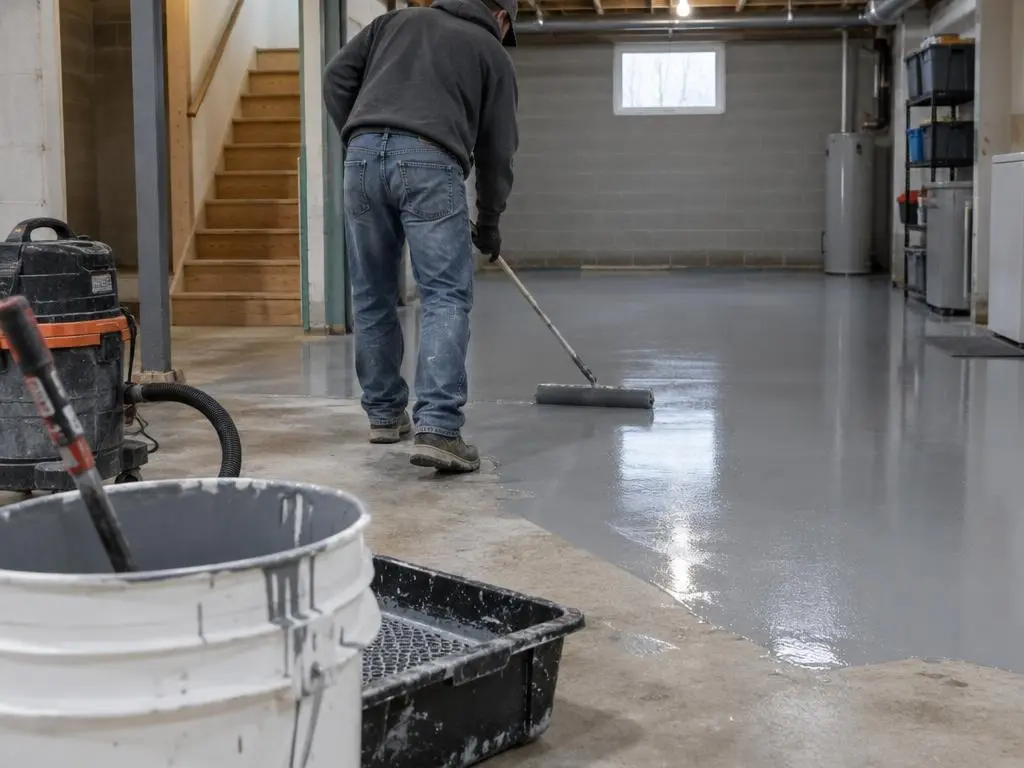
Basement floor epoxy turns a dusty gray slab into a sealed floor that is easy to clean and brighter to work in. In Carmel we coat basements used for storage, laundry, home gyms, workshops and playrooms. The concern below grade is moisture, and that is where our estimate starts.
Why moisture comes first
Central Indiana basements often sit in heavy, slow-draining soil. USDA's official soil series description for Crosby, a soil common on Indiana and Ohio till plains, calls it somewhat poorly drained, with a perched water table 0.5 to 2 feet below the surface in winter and spring. Brookston soils, also of large extent in Indiana, are listed as poorly drained. Wet ground around a foundation can push water vapor up through the slab. A coating that traps that vapor can blister or lose its bond, so we test before recommending anything.
Humid summers and cold slabs
Indianapolis-area summers are hot and humid, and the annual average relative humidity in the long-term climate table is 72.3%. When humid air reaches a cool basement slab, it can condense on the surface. That is separate from vapor coming up from below, but it still affects cure and bond. We check the dew point on install day and recommend running a dehumidifier before and after.
Radon and sealing the floor
The American Lung Association notes that all Indiana counties are in EPA radon Zone 1 or Zone 2, meaning medium to high potential for elevated levels. A coating seals the floor surface and cracks, but it is not a radon mitigation system. Test first. If a mitigation system is going in, we coordinate so the coating goes around the suction point.
Signs your basement slab needs attention
- Damp patches, white mineral deposits or efflorescence on the slab
- A musty smell, especially in summer
- Cracks, a rough surface or old paint that flakes
- Dust that coats stored items
- Paint or carpet adhesive left from an earlier finish
Choosing a system
Most basement floors get a moisture-tolerant epoxy primer, a solid color or flake coat and a clear topcoat. Gyms can take a thicker build. Finished rooms often go metallic. Areas near a sump or floor drain get a sloped finish so water still runs to the drain. If a slab shows active seepage or standing water, we tell you to fix the water first.
Ventilation and odor
Basements have less airflow, so we plan ventilation for each job and choose low-odor products where the system allows. We tell you how long to keep the area clear and when the furnace and water heater area can be used normally.
What This Covers
Basement work covers testing, prep and a coating system matched to the slab's moisture.
Slab moisture testing
Readings taken before the quote so the primer matches the slab.
Moisture-tolerant primer
A primer rated for higher vapor levels when testing calls for it.
Crack and joint repair
Cracks, pits and joints filled before coating.
Drain and sump detailing
Coating feathered to drains so water keeps flowing where it should.
Typical Basement Floor Epoxy Costs
| Item | Published range |
|---|---|
| Installed epoxy, per square foot | $4 to $10 |
| Basement floor (300 to 2,000 sq ft) | $1,200 to $20,000 |
| Moisture barrier, if needed | about $1 extra per sq ft |
| Crack and chip patching | $25 to $250 |
| Power washing | $0.35 to $0.77 per sq ft |
National ranges from HomeGuide (epoxy and power washing), Bob Vila (moisture barrier) and HomeAdvisor (patching). Moisture, old paint and repairs change the total. Your written estimate is the price.
How It Works
1. Test the slab
Moisture readings, a look at drains and cracks, and measurements.
2. Plan the system
Primer and finish written into your quote based on the readings.
3. Grind and repair
Dust-controlled grinding, then cracks and joints filled.
4. Coat and ventilate
Primer and finish coats applied with ventilation planned for the space.
Basement Floor Epoxy Questions
Can you epoxy a basement floor that gets damp?
Often, if the dampness is vapor and not running water. We test the slab and use a moisture-tolerant primer when needed. Active leaks or seepage need to be fixed first.
Does epoxy stop radon?
No. It seals the surface and cracks, which can help as part of a plan, but radon mitigation is a separate system. Indiana counties are all in EPA Zone 1 or 2, so test before you coat.
Is basement epoxy cold underfoot?
The coating takes on the slab's temperature, so it feels like concrete. Area rugs work well on top, and a flake finish feels less slick in socks.
How long before I can use the basement again?
Light foot traffic is usually fine within a day, and furniture can go back after a few days depending on the product. We give you written times.
Basement Floor Epoxy Service Areas
- Epoxy Flooring in Carmel, IN
- Epoxy Flooring in Indianapolis, IN
- Epoxy Flooring in Westfield, IN
- Epoxy Flooring in Fishers, IN
- Epoxy Flooring in Noblesville, IN
- Epoxy Flooring in Zionsville, IN
- Epoxy Flooring in Whitestown, IN
- Epoxy Flooring in Cicero, IN
- Epoxy Flooring in Sheridan, IN
- Epoxy Flooring in Arcadia, IN
- Epoxy Flooring in Lebanon, IN
- Epoxy Flooring in McCordsville, IN
- Epoxy Flooring in Fortville, IN
- Epoxy Flooring in Lawrence, IN
- Epoxy Flooring in Meridian Hills, IN
- Epoxy Flooring in Williams Creek, IN
- Epoxy Flooring in Speedway, IN
- Epoxy Flooring in Brownsburg, IN
- Epoxy Flooring in Greenfield, IN
- Epoxy Flooring in Pendleton, IN
- Epoxy Flooring in Lapel, IN
- Epoxy Flooring in Anderson, IN
Get a Basement Floor Epoxy Estimate
Free basement floor estimates with moisture testing in Carmel.