
Faster return to service
Polyaspartic Floor Coating in Carmel, IN
Walk on it the same day and park on it the next, depending on the product and temperature.
- Free on-site estimate with a slab moisture test
- Itemized written quote that names every coat
- Full diamond grind on every floor we coat
When Polyaspartic Makes Sense
Polyaspartic floor coating is a type of aliphatic polyurea that cures much faster than standard epoxy. HomeGuide puts a full cure at about 24 to 48 hours, compared with up to a week for epoxy. For a Carmel family that parks two cars in the garage every night, that difference often decides the choice. It is also more UV-stable, so it keeps its color where sunlight reaches the floor.
Speed and scheduling
Bob Vila's cost guide says polyaspartic floors can usually take foot traffic after 3 to 4 hours and vehicles after about 24 hours, while epoxy needs about 12 hours before walking and three days before driving. We confirm times for your product and the slab temperature. Faster cure also means less time for dust, bugs or a curious pet to land in the wet coat.
Sunlight and color
Epoxy can yellow when it sits in direct UV over time. Garages that face west, porches and floors near large doors get afternoon sun in an Indiana summer, where the July mean is about 75.8°F and days run long. A polyaspartic finish resists that yellowing, which matters most on light grays and whites.
Temperature range
Polyaspartic products are known for curing across a wider temperature range than epoxy. In Carmel that helps in late fall and early spring, when an unheated garage is cool but not frozen. Every product still has minimum slab and air temperatures, and we check both on the day.
Full polyaspartic or hybrid
Some floors get polyaspartic in every layer. Others get an epoxy base, which builds thickness and is more forgiving on porous concrete, with a polyaspartic topcoat for UV and wear. HomeGuide lists polyaspartic coats at about 2 to 6 mils each and epoxy at about 10 to 20 mils, so the hybrid approach is common when the slab needs more build. We pick the stack after testing the floor.
Prep is the same, or stricter
A fast cure leaves less room for error. The floor has to be ground, clean and dry, and the crew has to work quickly in sections. We diamond grind the full slab, fill cracks and spalls and degrease stains before mixing any material. Moisture testing matters too. Bob Vila notes that a moisture barrier adds about $1 per square foot when a slab needs one.
Where we use it
- Garages where you need the cars back inside quickly
- Garages, porches and patios that get direct sun
- Topcoats over flake and solid-color epoxy
- Light commercial spaces that cannot close for long
What This Covers
We install polyaspartic as a full system or as a topcoat over an epoxy base.
Full polyaspartic system
Primer, color or flake coat and clear, all polyaspartic, for the fastest return to use.
Epoxy base, polyaspartic top
Thicker epoxy build underneath with a UV-stable polyaspartic finish.
Flake or solid color
Either finish works under a polyaspartic clear coat.
Moisture-tolerant primer
Used when the slab test shows more vapor than the coating can handle on its own.
Typical Polyaspartic Floor Coating Costs
| Item | Published range |
|---|---|
| Polyaspartic, per square foot (HomeGuide) | $5 to $12 |
| Polyaspartic, per square foot (Bob Vila) | $4 to $9 |
| One-car garage (288 to 392 sq ft) | $1,400 to $4,700 |
| Two-car garage (400 to 576 sq ft) | $2,000 to $6,900 |
| Three-car garage (576 to 864 sq ft) | $2,900 to $10,400 |
| Moisture barrier, if needed | about $1 extra per sq ft |
National ranges from HomeGuide (polyaspartic cost guide) and Bob Vila. The system, prep and flake coverage change the total. Your written estimate is the price.
How It Works
1. Test and plan
We measure, check moisture and slab temperature and decide between a full or hybrid system.
2. Prep
Diamond grind, vacuum, crack and spall repair, and degreasing.
3. Coat in sections
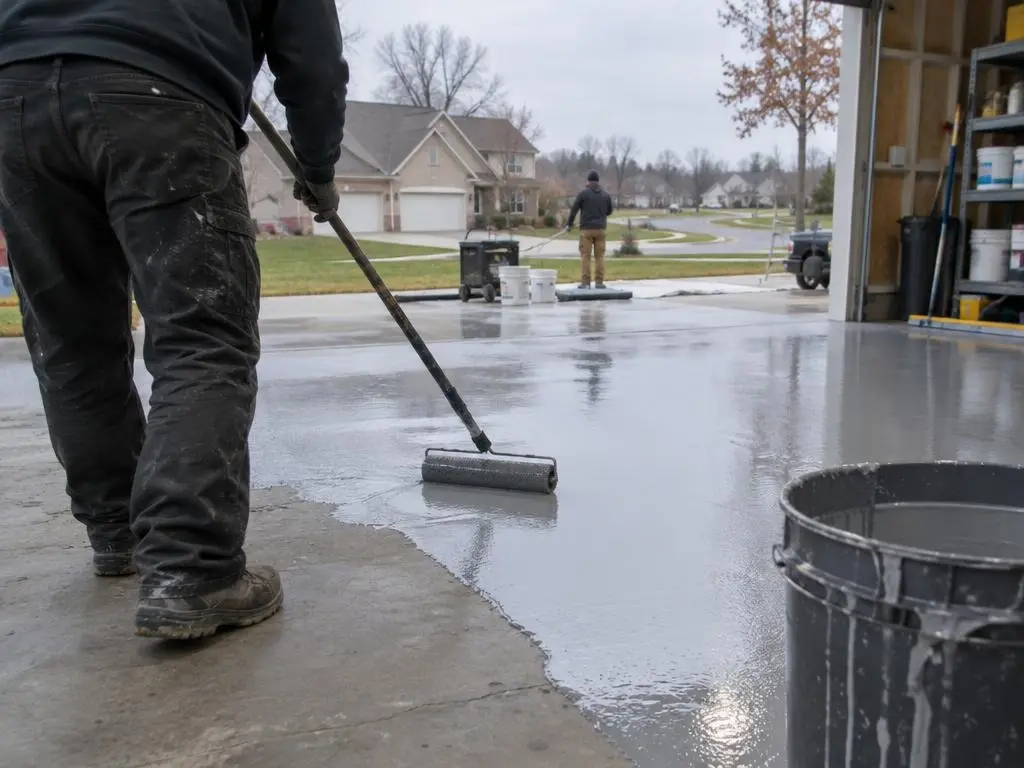
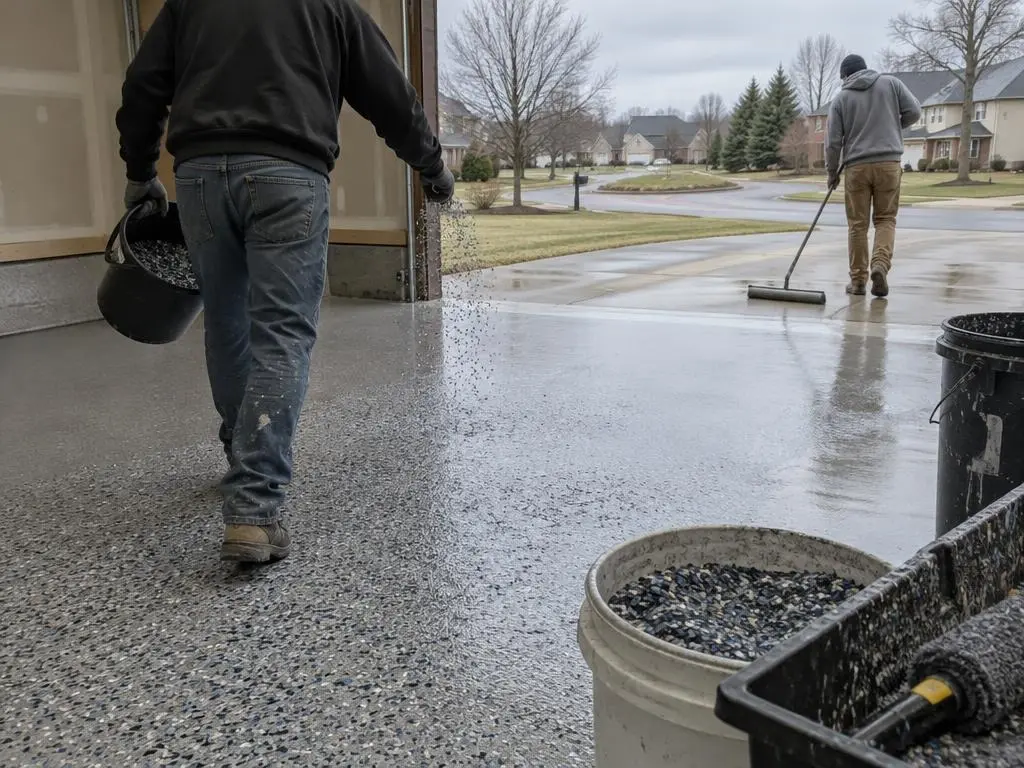
Fast-curing material is applied in workable sections, with flake or color as chosen.
4. Return to use
Written times for walking and parking, usually much sooner than epoxy.
Polyaspartic Floor Coating Questions
Is polyaspartic better than epoxy?
It cures faster and resists UV better. Epoxy builds thicker per coat and costs less. Many floors use both: an epoxy base with a polyaspartic topcoat.
How long does polyaspartic floor coating last?
HomeGuide estimates 10 to 20 or more years for residential polyaspartic floors. Prep quality and how the floor is cleaned in winter affect that.
Can polyaspartic be installed in one day?
Many garage floors can be ground, coated and walkable in one day. Parking usually waits about 24 hours. Repairs or a moisture primer can add time.
Is polyaspartic a good DIY project?
HomeGuide rates it as not DIY-friendly. It cures fast, so it has to be mixed and spread quickly and evenly, and mistakes are hard to fix once it sets.
Polyaspartic Floor Coating Service Areas
- Epoxy Flooring in Carmel, IN
- Epoxy Flooring in Indianapolis, IN
- Epoxy Flooring in Westfield, IN
- Epoxy Flooring in Fishers, IN
- Epoxy Flooring in Noblesville, IN
- Epoxy Flooring in Zionsville, IN
- Epoxy Flooring in Whitestown, IN
- Epoxy Flooring in Cicero, IN
- Epoxy Flooring in Sheridan, IN
- Epoxy Flooring in Arcadia, IN
- Epoxy Flooring in Lebanon, IN
- Epoxy Flooring in McCordsville, IN
- Epoxy Flooring in Fortville, IN
- Epoxy Flooring in Lawrence, IN
- Epoxy Flooring in Meridian Hills, IN
- Epoxy Flooring in Williams Creek, IN
- Epoxy Flooring in Speedway, IN
- Epoxy Flooring in Brownsburg, IN
- Epoxy Flooring in Greenfield, IN
- Epoxy Flooring in Pendleton, IN
- Epoxy Flooring in Lapel, IN
- Epoxy Flooring in Anderson, IN
Get a Polyaspartic Floor Coating Estimate
Free estimates for polyaspartic floor coating across Hamilton County.